For more than six centuries, scholars, cryptographers, and mystics have struggled in vain with the Voynich manuscript.
They saw plants, stars, and alchemy – but they missed the obvious.
This is not a collection of enigmatic drawings. It is a hidden manual – a guide to the deepest mechanisms of life itself, disguised as mysticism so that its knowledge would not be lost.
When the images are read correctly, the entire manuscript changes its character.
It is not merely a mystery – it is a revelation, written by minds who knew more than we do today.
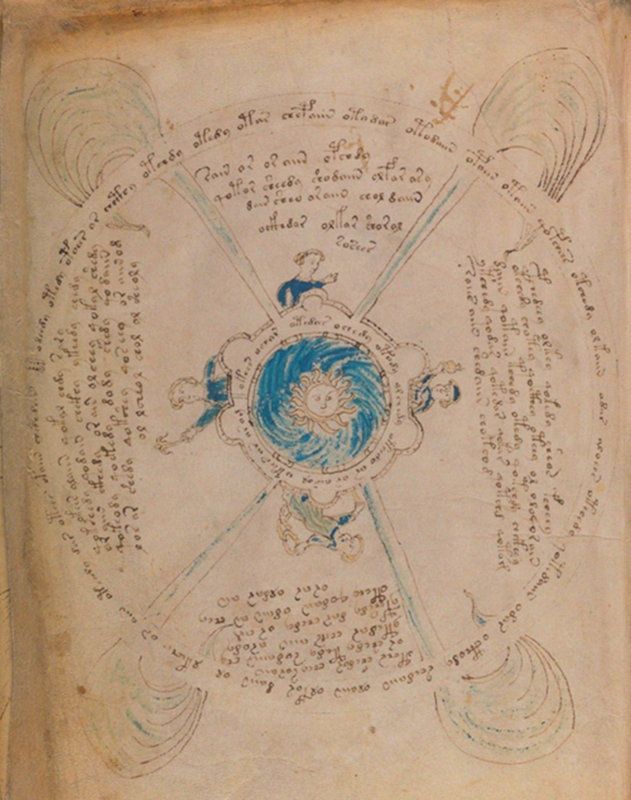
Folio 85r – The Four Phases of Ovulation and the Egg’s Journey
This image presents a visual representation of the days in a woman’s cycle when ovulation occurs.
At the center, we see the egg as the core of life, surrounded by a thin membrane.
The four petal-like lobes extending outward represent the hormonal changes and the movement toward the egg during the days around ovulation.
The color transitions from yellow to green and blue symbolize the shifts in hormones and energies, while the female figures around the image illustrate the various stages of the process.
Forbedret version (samme mening som dansk – bare skarpere)
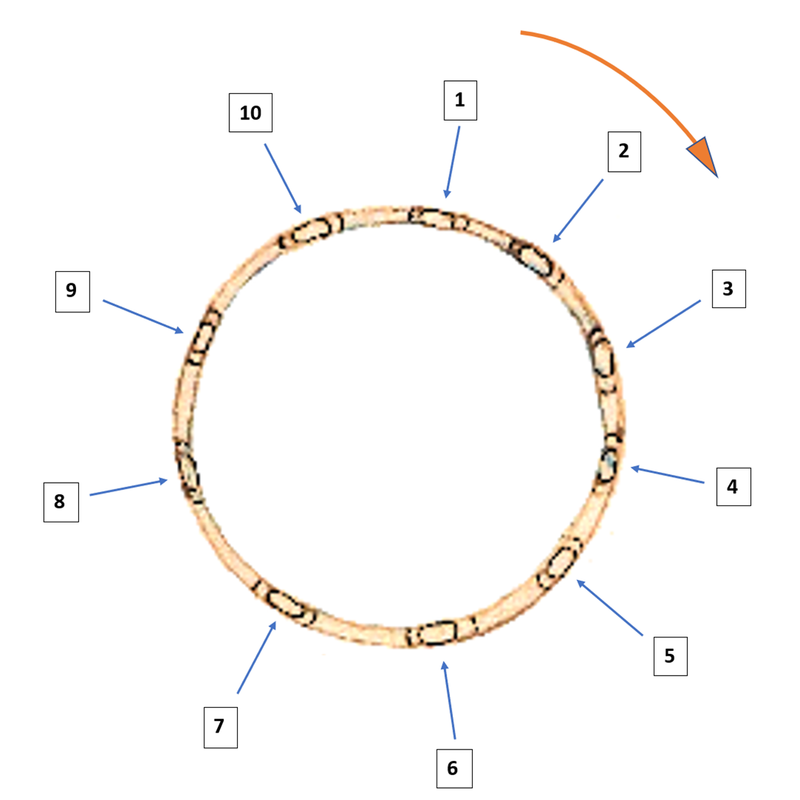
The Beginning of the Cycle – The Egg’s First 10 Days
This innermost ring marks the start of the woman’s cycle and the first 10 days, during which the egg matures inside the follicle.
Each small marking represents one day in the pre-ovulatory phase, where hormones gradually build up and the body prepares for ovulation.
The ring functions not only as a timekeeper, but also as a visualisation of the egg’s protective membrane – the layer that encloses the cell in this early phase and keeps it stable while it grows.
The circular shape expresses both the rhythmic, enclosed process and the natural barrier between the egg and its surroundings until ovulation is reached.
By day 10, both the hormonal balance and the egg’s membrane are primed for the transition into the four critical days (days 11–14), when the actual release takes place – reflected in the next ring of the image.
The Internal Structure of the Egg – The Female Cycle from Day 1 to Ovulation
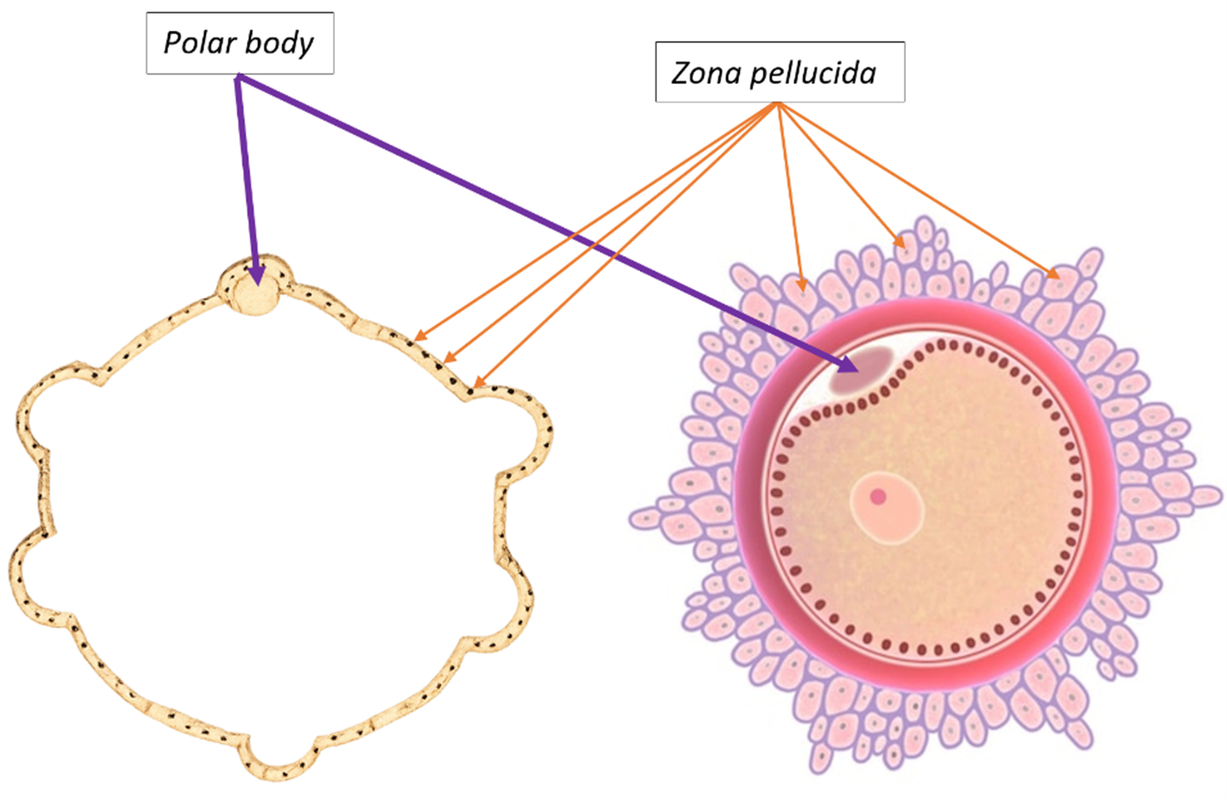
This image presents a direct connection between the circular symbol in the Voynich manuscript and the actual structure of the human egg.
The small cell at the top is the polar body, formed during maturation, and it serves as a key marker of the egg’s biological age and quality.
The outer ring, indicated by the orange arrows, represents the zona pellucida – the egg’s protective membrane, which plays a crucial role in both fertilisation and implantation.
The Voynich image reflects not only the egg as a structure, but the entire first half of the female cycle (approximately days 1–14) leading up to ovulation.
The inner ring represents the first 10 days of maturation, while the four prominent points mark the transition into the critical hormonal phase approaching ovulation.
The small oval symbols function as a biological “time code”, tracking the egg’s journey day by day.
The distinctive “bulges” seen in the Voynich drawing (visible along the egg’s contour) are not mistakes or random features.
They serve as a double marker: both as a protective membrane and as a visual key for reading the cycle in another layer of the image.
The egg itself should be understood as round, but the manuscript’s creator has added an explanatory layer – a double-coded visualisation of process and protection.
That a 15th-century manuscript depicts both the polar body and zona pellucida in biologically accurate proportions – while also reflecting the entire maturation process leading up to ovulation – stands as one of the strongest pieces of evidence that the image is not arbitrary, but a deliberate decoding of life’s initiating mechanism.
Folio 85r – The Core Mechanism of Ovulation and Its Hormonal Signature
This image from the Voynich manuscript is not an abstract illustration, but a precise visual encoding of the key days of ovulation and the initial stage of fertilisation.
Everything in the image – from the four women to the double wave pattern – points to an advanced understanding of the female reproductive cycle, remarkably aligned with modern biological knowledge.
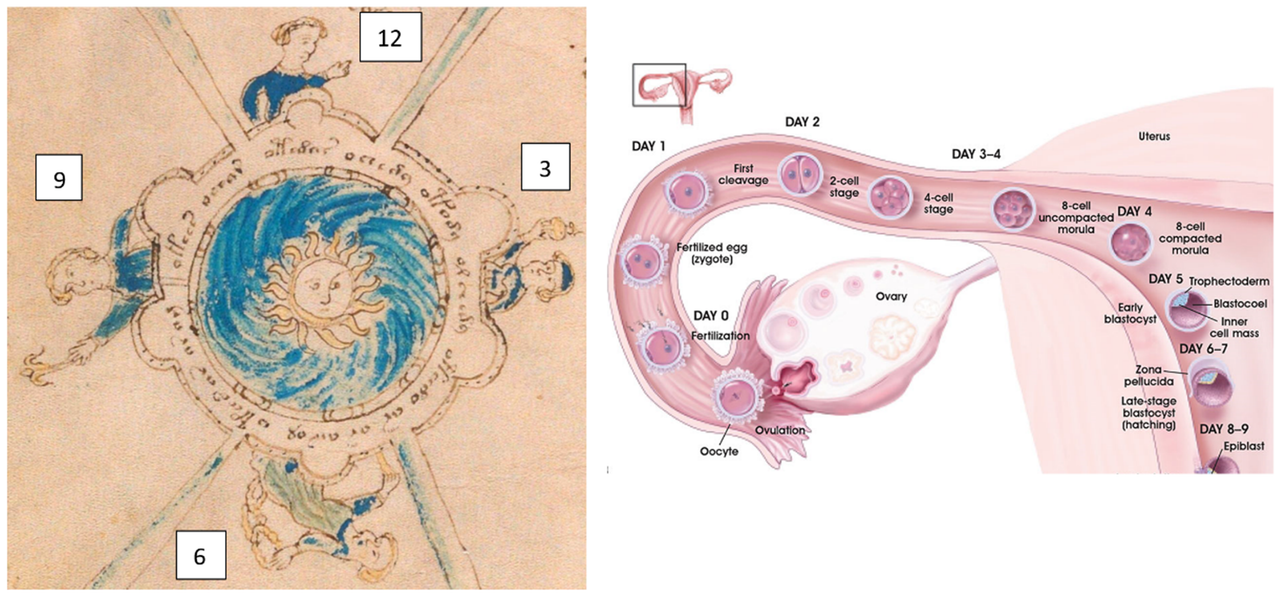
Woman 9 – Day 14: The Moment of Ovulatory Release
Woman 9 represents the exact peak: the day of ovulation. Her posture is dynamic, almost as if she is throwing, and what she holds in her hand is unmistakably the egg being released from the ovary.
Behind her, two prominent wave-like arcs form a central code element:
• First wave – the physical expulsion of the egg from the follicle.
• Second wave – the hormonal surge (LH peak) that triggers ovulation and opens the gateway for fertilisation.
This double-wave symbolism is an exceptionally precise depiction of what we now know takes place on day 14: a simultaneous mechanical and hormonal thrust that propels the egg into the fallopian tube and toward the uterus.
That the manuscript’s creator chose to depict both layers of the process as rhythmic arcs of energy clearly shows that this is no decorative flourish – but a deliberate physiological code.
Woman 12 – Day 11: The Gateway and the Preparation
Woman 12 does not represent day 14, but rather days 11–12, when the body prepares for the actual release. Her forward-pointing finger is no coincidence – it marks the transition to the fertile gateway. At this point, the cervical mucus changes dramatically, guiding the sperm and creating the optimal path toward the egg.
That she points directly at Woman 3 serves as a visual “signpost” – a bridge between ovulation and the coming fertilisation.
She carries nothing in her hands, but her pointing gesture is a code in itself: an activation, a signalling, a marking of timing.
What she represents is not the egg itself, but the readiness within the follicle – the moment when the system is primed but has yet to release anything. She stands at the threshold of the opening to fertility.
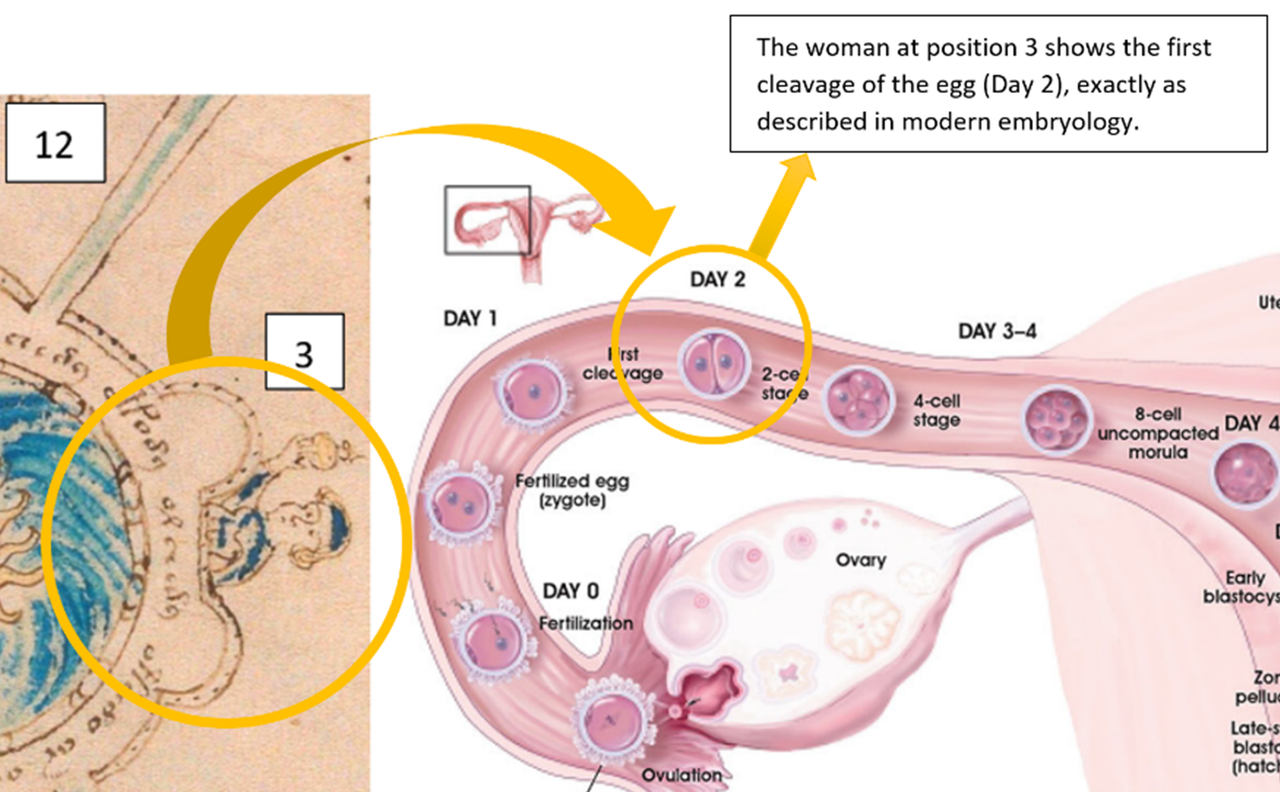
Woman 3 – Day 2: The First Cell Division
Woman 3 holds a small, round structure in her hand – a direct depiction of the 2-cell stage.
It is an uncannily precise match to what we see in modern embryological diagrams.
Her gesture is both protective and presenting at the same time, as if she is displaying the very first sign of life after fertilisation.
This is not just a “decorative ring” – it is the manuscript’s visual marker of the zygote’s first division.
Woman 6 – Day 3–4: Multiplication and Activation
Woman 6 is shown in a distinctly active posture: she presses a rod with a rounded tip downward toward the ground – like a kind of ignition rod or signal staff.
In her other hand, she holds a string of interconnected rings, visually resembling a tense row of cells – perhaps 4 or 8 in total – like a compact embryo cluster.
This duality is no coincidence:
• The rod marks activation – the moment when the embryo switches on its own genome and takes control of its development for the first time.
• The string of spheres in her hand represents the actual cell division, where the embryo reaches the 4- and 8-cell stages and begins to organise itself as a structure.
It is a double code of action and form:
the rod shows process and energy, while the spheres show number and rhythm.
The artist has, in all likelihood, captured exactly this turning point – where growth becomes organisation – with symbolic precision that is visual, biological, and energetic at once.
The Double Waves – Energy and Biology as One
The two waves beside Woman 9 are among the strongest pieces of evidence for the image’s biological coding.
They show not just motion, but a double pulse:
• The physical movement of the egg.
• The invisible hormonal wave required for ovulation to occur at all.
This dual language – physical + energetic – is present throughout the entire image and helps explain why the Voynich manuscript cannot be read as either pure text or pure illustration.
It is a hybrid of biological diagram and symbolic energy map.
Conclusion
Folio 85r is not a mythological image, but a coded biological sequence:
• Woman 12: Days 11–12, gateway to fertility, sperm guidance.
• Woman 9: Day 14, ovulation, double wave of egg and hormonal peak.
• Woman 3: Day 2 after fertilisation, first division of the zygote.
• Woman 6: Days 3–4, 8-cell stage, multiplication and growth.
That the manuscript depicts these processes with a level of precision only confirmed by modern embryology centuries later makes this page one of the strongest pieces of evidence that the Voynich manuscript contains an advanced biological understanding.
The Sun and the Four Women – The Hormonal Clock of Life
The centre of folio 85r is not just a decorative motif, but a precise diagram of the hormonal cycle of ovulation and the first steps toward fertilisation.
The sun in the middle represents the egg itself – the starting point of life.
Around it, colours, women, and energies move like a biological clock, where each shade represents a distinct phase in the process.
Colours as Biological Code
The colours of the women are not mere decoration – they are the very key to the image.
Each shade is placed with precision to indicate hormonal phases:
the intense blue on Woman 12 marks the LH surge and the beginning of ovulation,
the green tone on Woman 6 indicates the transition zone between oestrogen and LH,
and the golden hues on Woman 3 and the rings she holds represent the mature oestrogen phase and the egg’s division.
The colours form a deliberate biological code, tying together the women, the central sun, and the blue hormone tubes into a single, unified cycle.
Without this colour architecture, the true function of the image would remain hidden.
The Blue Spiral and Woman 12 – Day 11 and the LH Surge
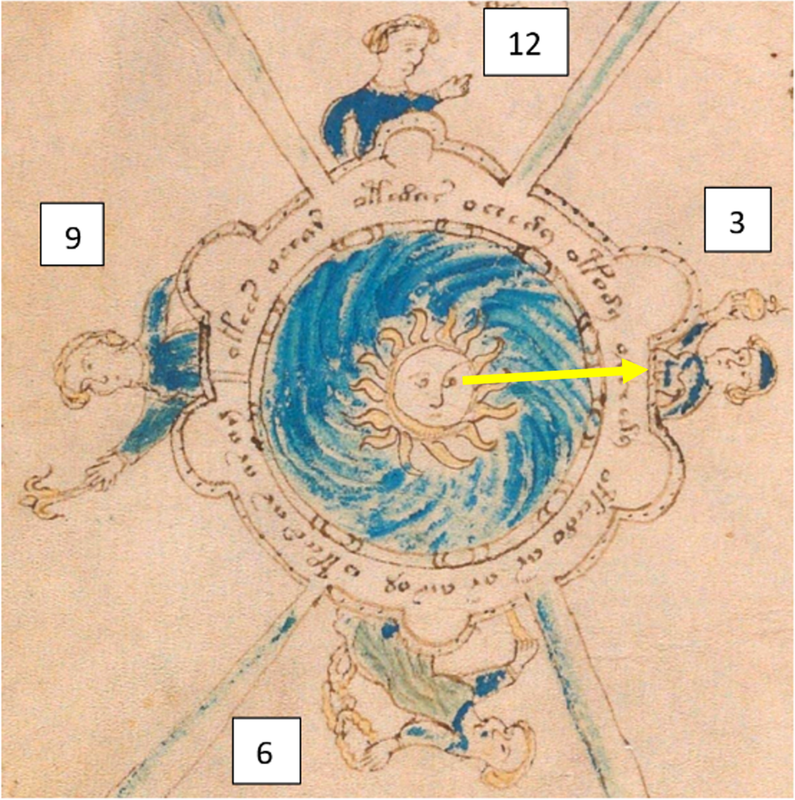
The intense blue spiral winding toward the egg represents the LH surge (luteinising hormone), which triggers ovulation.
Woman 12, positioned at the point of deepest blue, wears a striking, almost pure blue dress. This is no coincidence – she marks day 11, the moment when the system shifts from the oestrogen phase into activation.
She is the “ignition point,” where hormonal energy gathers and channels toward the egg.
Her pointing finger, aimed at Woman 3, can be seen as the signal that clears the path for the sperm.
Woman 3 and the Golden Egg – Day 1–2
On the opposite side sits Woman 3, holding a small golden egg in her hand.
The colour is not mere decoration – it represents the fertilised egg in its earliest stage.
This image marks the transition from ovulation to the beginning of life: day 1–2 after fertilisation, when cell division begins.
The golden tone of the egg reflects the life-giving role of oestrogen and symbolises the lingering “warmth” from the maturation phase.
Woman 6 and the Green Tones – Day 3–4, Transition and Division
Woman 6 is dressed in a distinct green tone – a key to understanding the image.
Here, green serves as the transition between oestrogen’s yellow and LH’s blue, just as in the body, where days 12–13 are a hormonal blend.
She holds a string of golden rings – a clear reference to the early cell divisions: 2-cell, 4-cell, 8-cell stages.
The fact that the rings are yellow indicates that, although the LH process is now active, the division still carries the imprint of the oestrogen phase.
A single bulge in her field, together with the cluster of rings, signals that cell division is accelerating at this stage.
Woman 9 and the Egg’s Release – Day 14
Woman 9, positioned near the next large wave, is linked to the moment of ovulation – day 14.
Her posture and movement depict the egg being released from the follicle and entering the uterus.
The colours around her shift from yellow to blue, matching the biological moment when oestrogen drops and the LH surge completes its task.
Her role is to mark the climax of the cycle – the shift from preparation to action.
The Sun as Centre – The Egg and Its Energy
The sun at the centre, with its golden face, is both poetic and precise: it represents the egg, the spark of life, and the hormonal core where all colours and signals converge.
The blue spiral winding into it is not decorative – it is the flow of hormones.
The long blue tubes stretching from the spiral flanges toward the centre show how the yellow energy of oestrogen transforms into LH’s blue as it approaches the moment of release.
The Gaze of the Sun and the Key to Ovulation
It is likely no coincidence that the sun in the centre of folio 85r turns its face directly toward Woman 3.
The same precise alignment is repeated in folio 86v, where the moon shines toward that exact position.
This pattern reveals a surprisingly modern insight: that light – especially sunlight – is an active factor in triggering ovulation.
Today we know that vitamin D and natural light influence both oestrogen and LH, both of which are essential for releasing the egg.
In the cycle, Woman 3 represents day 12 – the critical moment just before ovulation.
That the illustrator chose to mark this point with the sun’s direct gaze is a deliberate signal: the light of life activates life’s centre.
Together, folios 85r and 86v express a deep understanding that the rhythms of sun and moon – day and night, masculine and feminine – work together to govern the precise timing of fertility.
The Code of Colours
• Yellow: Oestrogen phase and follicle maturation
• Green: Transition between oestrogen and LH (days 12–13)
• Blue: LH surge and hormonal activation
• Golden rings: Early cell divisions, still powered by oestrogen’s energy
In summary, folio 85r is a visual hormone wheel:
Woman 12 ignites the process,
Woman 3 marks the beginning of fertilisation,
Woman 6 shows the acceleration of cell division,
and Woman 9 represents the actual release.
The colours tie everything together and precisely reflect the biological reality of the female cycle.
The Hidden World of Cilia – The Fallopian Tube’s Inner Motor in Voynich 85r
The outermost layer of the image – the four feather-like structures – is not decorative.
They are a biologically accurate representation of the microscopic cilia inside the fallopian tube, the body’s built-in transport system for moving the egg from the ovary toward the uterus.
Every tiny line in the drawing corresponds closely to what we can see under a microscope today: rhythmic waves and folds moving in coordinated patterns to create propulsion.
That someone over 600 years ago depicted this anatomical system with such precision means we are not looking at fantasy or guesswork – but at a deliberate and detailed portrayal of microscopic reality.
And yet, here it is, embedded in the Voynich manuscript as a hidden illustration of the mechanics of life.
What we are seeing is not symbolism – it is biology in coded form.
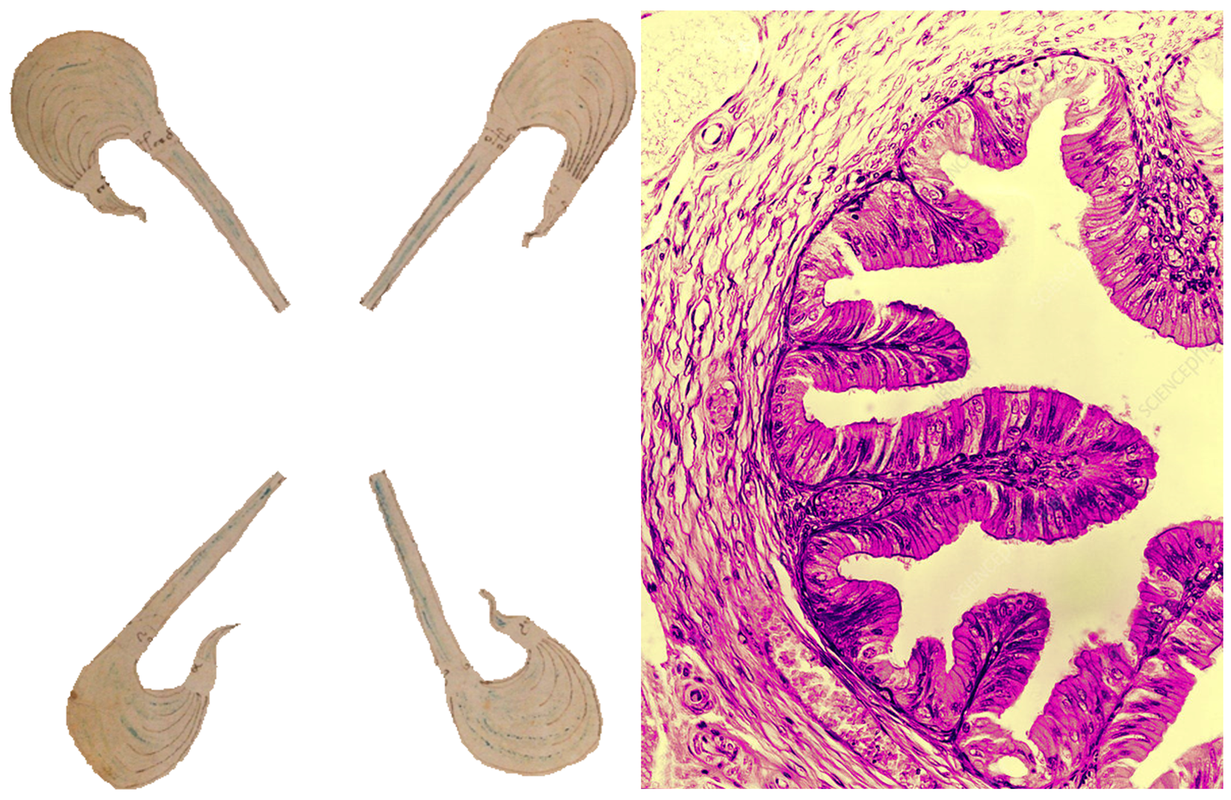
The four feather-like structures do not merely indicate movement in a single direction.
The cilia in the fallopian tube work in coordinated waves, but the egg’s journey is not linear like a conveyor belt – it is gently rocked back and forth, held in a protective environment until the right time and place for fertilisation.
This is exactly what is captured here: at the “12 o’clock” position, we see the cilia catching the egg just after its release from the ovary.
At “3 o’clock,” the structure points back, and the woman in that position holds the first sign of cell division in her hand – day 2 in modern embryology.
It aligns perfectly with what we now know about the egg’s movement through the fallopian tube.
But the most striking detail is the colour.
The entire structure is covered in green pigment – and this is no coincidence.
Green is the visual code for the brief hormonal window in which oestrogen and the LH surge overlap.
This transitional moment is precisely what activates the cilia and initiates the egg’s transport.
Green is therefore not just a decorative hue; it is a direct indication that the illustrator understood the role of hormones in the process.
Yellow in the outer areas (oestrogen), gradually blending into blue (LH), creates the green in-between: a visual language for the biological shift from preparation to action.
This mirrors what modern reproductive biology describes today – yet here it is, captured in colour six centuries ago.
The microscopic reference image used in modern biology shows the folded walls of the fallopian tube, covered in dense cilia.
The structure matches the Voynich image point for point: long, wavy lamellae, rhythmic repetition, and the funnel-like formation around the egg that guides it through the system.
What we are seeing is a visual rendering of the ciliated epithelium of the fallopian tube – a precise anatomical system that was not described with certainty until many centuries later.
When we look at the four feather-like structures in Voynich 85r with this knowledge, there can be no doubt:
This is not myth or fantasy.
It is a detailed mapping of a process that unfolds on a microscopic scale.
The colour code (yellow → green → blue) reveals an understanding of hormonal interaction, and the specific forms match what can only be seen today through advanced microscopy.
This makes the image one of the most compelling pieces of evidence that the manuscript contains genuine biological knowledge – and that the colours themselves are part of its scientific language.
Caption (for the image with Woman 12 and the text containing 19 words)
“The woman in position 12 – gatekeeper and hormonal key”
The text above Woman 12 consists of 19 words and initiates the entire structure of the cycle.
She sits at the top – like 12 o’clock on a clock face – and is dressed in blue, a colour which throughout the manuscript often indicates hormonal activity.
She points forward, and it is precisely here that the egg’s journey through the fallopian tube begins.
We do not know with certainty what the text says, but everything suggests that it describes the hormonal activation and the beginning of ciliary movement.
Our three strongest interpretation proposals (shown below) are all biologically accurate and correspond closely to what actually happens in the body on day 11 of the female cycle.
The likelihood is therefore extremely high that the text refers to:
– that the cilia are activated,
– that the egg will soon begin to move,
– that this happens under the influence of oestrogen,
– and that the timing is governed by the body’s own rhythm.
That someone 600 years ago encoded this biological moment into both image structure and text makes this section one of the strongest indications that the Voynich manuscript contains genuine microscopic and cycle-based knowledge.
Note on word count in the 12 interpretation proposals
In the analysis of the four women (positions 12, 3, 6, and 9), three realistic proposals have been presented for what each of their texts might mean – a total of 12 interpretation attempts.
The texts in the Voynich manuscript often consist of a fixed number of words, for example 19, 22, 26, or 35, and these numbers are indicated for each woman.
In a few of the proposals, however, the word count may differ by one or two words.
This is due partly to the rhythmic and biologically expressive style of the translation, and partly to the fact that there is still no definitive clarity about how meaning and word structure are encoded in the original system.
The 12 text proposals should therefore not be read as literal translations, but as close, meaning-focused interpretations.
Each proposal has been constructed based on the woman’s function, colours, posture, and biological phase – and it is precisely this internal coherence that ensures the manuscript’s inner logic is preserved.
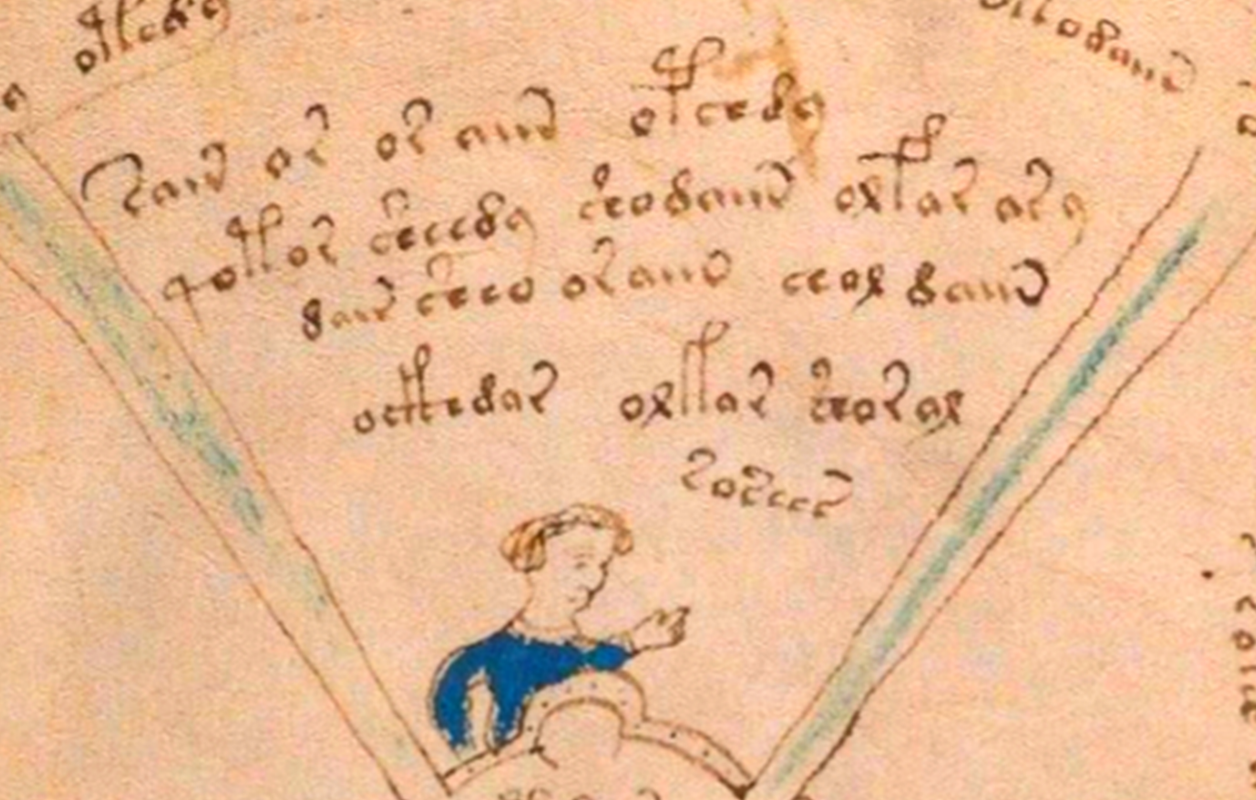
The Text Code at Woman 12 – Three Possible Interpretations
The long text above Woman 12 consists of 19 words and stands out clearly from the rest of the circle.
It is strategically placed exactly where the sun is highest and where ciliary movement begins.
We assess that the text serves as a kind of start code or instruction for activating the fallopian tube – whether hormonally, mechanically, or symbolically.
Here are three likely interpretations, based on the image’s internal logic, cycle day, colour language, and biological function:
Interpretation 1 – Hormonal Activation and Opening Signal
“Now the inner current begins.
Open the blue gate and follow the weather.
The cells are waiting – the sun sets the pace.
The cilia are ready to carry it in.”
Explanation
This text describes the shift from a resting to an active state.
“The blue gate” refers to Woman 12 and the oestrogen peak.
“Follow the weather” is a poetic reference to the sunlight at the centre – the signal that sets the system in motion.
Interpretation 2 – Ciliary Movement and Hormonal Control
“The light is strong and the gate is open.
Movement begins along the edge.
Each wave is driven by the body’s song.
The blue woman gives the signal.”
Explanation
Here, the focus is on the rhythm of the cilia themselves.
The text may reflect a kind of microscopic instruction: how the egg is moved forward through wave-like movements, driven by hormones – “the body’s song.”
Interpretation 3 – Biological Time Signal
“Day 11 is the beginning.
Oestrogen is high – blue is the signal.
Cilia awaken and point toward the future.
Division is near.”
Explanation
This version interprets the text as a kind of cycle logbook.
Woman 12 = day 11. Hormone levels are high, the cilia are active, and fertilisation is near.
The text becomes a sort of biological status update.
First Cell Division – Woman 3 Holds the Beginning of Life
At position 3, we see the egg divided in two – a precise depiction of day 2 in the embryology calendar.
The woman in blue stands as a witness to the transformation and holds the first sign of life in her hand.
The surrounding text consists of 22 words and is interpreted here in light of the moment of division and the hormonal environment of the fallopian tube.
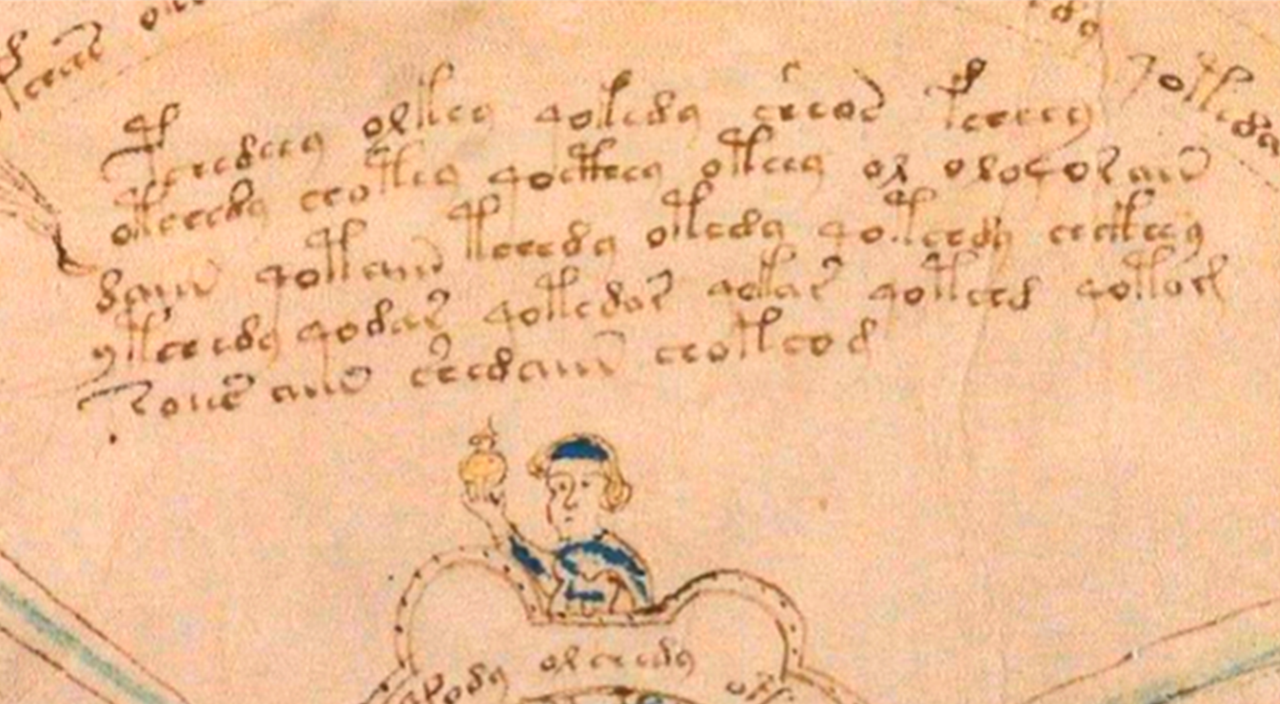
Interpretation of the Text at Woman 3 – Cell Division and Day 2
The text field above Woman 3 contains 22 words and follows directly after the activation at Woman 12. She now holds the egg in her hand – divided in two – and initiates the next phase in the embryology calendar. The text can be read as a poetic explanation of this biological transformation.
Interpretation 1 – “The First Step in Life”
“It has now begun. Two have become from one.
The cilia continue their dance.
The blue rhythm carries the cells forward.
Everything proceeds as it should.”
Explanation
A poetic yet precise interpretation of the first cell division.
“Two have become from one” is the core message.
The movement continues, and everything unfolds under hormonal regulation.
“The blue rhythm” still refers to the oestrogen peak.
Interpretation 2 – “Observation and Balance”
“Look – the egg is dividing. Two circles have formed.
The journey is calm, like the wind in the womb.
The cilia sense it and align themselves.
Nothing must happen too early.”
Explanation
Here, the focus is on balance and timing.
The journey depends on the correct speed and environment.
“Nothing must happen too early” refers to biological precision:
if transport is too fast, errors may occur.
Interpretation 3 – “Day 2 – The First Transformation”
“Day 2. A new shape has arrived.
Two parts, one content.
The hormones keep the rhythm.
The cilia carry it into the darkness.
The woman remains calm.”
Explanation
This version is more precise and almost protocol-like.
The day is stated, the transformation described, and the process unfolds with a calm, controlled character.
“The darkness” may be interpreted as the interior of the fallopian tube – a space protected from light and disturbance.
Interpretation of the Text at Woman 6 – Coordination, Growth, and Cellular Consciousness
The text above Woman 6 is among the most content-rich in the circle and contains 26 words.
It marks the decisive shift to day 3, when the embryo, for the first time, takes control of its own development.
The process is no longer governed by the mother’s molecular instructions – the embryo now activates its own genome (Zygotic Genome Activation).
The green-blue woman is in distinct motion.
She leans actively forward, lifts the ring structure with one hand, and holds in the other a long yellow rod with a prominent tip – like an antenna, a conductor’s baton, or an ignition key.
The round spheres, linked together in a ring formation, correspond to the exponential cell divisions seen on days 3–4, when the embryo enters the 4- and 8-cell stages and begins to compact.
We are now at one of the most crucial stages in the entire embryological journey:
the moment when growth becomes structure –
when rapid proliferation of cells is replaced by organisation, cooperation, and coordinated signalling. The text above Woman 6 most likely offers a precise description of this process:
how the embryo “wakes up,” assumes control, and begins to shape its own destiny.
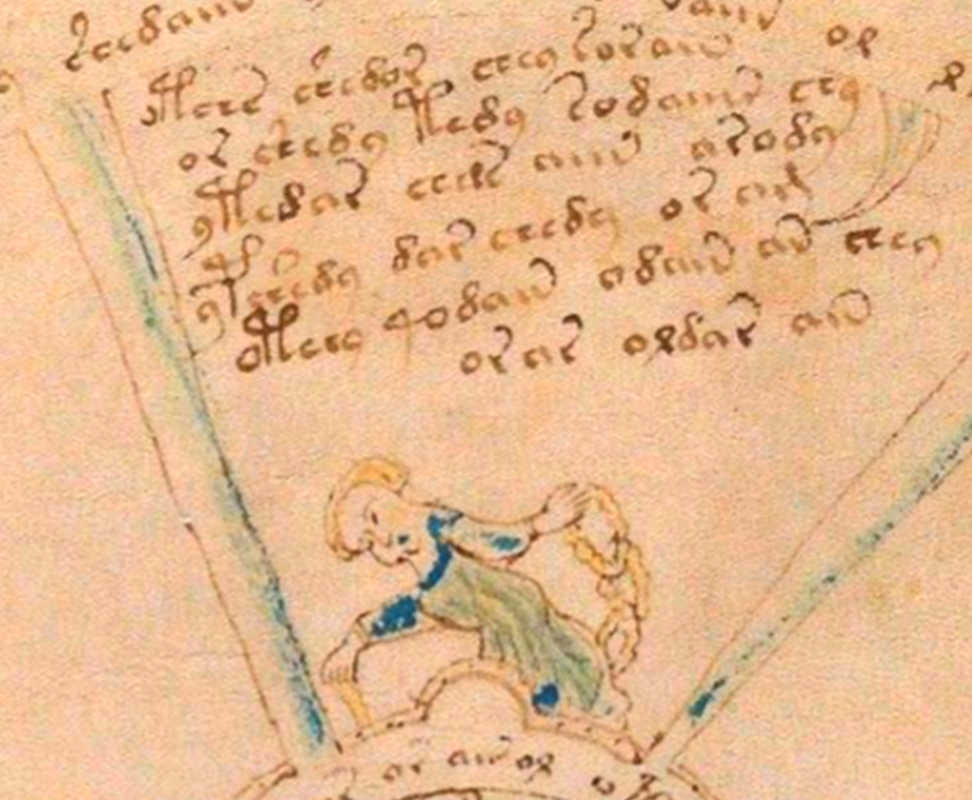
Interpretation of the Text at Woman 6 – Cell Division and Day 3
The text above Woman 6 contains 26 words and marks an important transition.
It is now day 3 in the fallopian tube, and the embryo has divided into at least 8 cells.
The woman is clearly active and leaning forward.
Her green dress signals high progesterone activity, while her blue shoulders indicate remaining levels of oestrogen.
She holds a rod with a sphere in her right hand and a chain of cells or rings in her left – likely a metaphor for the progression of cell division or the activation of the embryo’s own genome.
This is a key biological shift, clearly emphasised through position, colours, and the amount of text.
Interpretation 1 – “Genome Activation and Rhythmic Cell Growth”
“I open the inner flow,
in a rhythmic and purposeful pulse.
Circles of growth follow the rod in my hand.
Now we ignite our own codes.”
Explanation
The embryo activates its own genome.
The rod symbolises activation, and the ring in her hand reflects the organic progress of the cell cluster.
The cells now divide according to their own pattern – no longer guided from outside.
Interpretation 2 – “Progesterone Takes Over and Clustered Cell Division”
“The circle gathers its force in the morning light.
Green energy drives division into four and eight.
The rod shows the way in spiral motion.
Nothing is lost. Everything takes precise form.”
Explanation
“Green energy” represents progesterone, which dominates on day 3.
The cells divide in a spiral pattern, suggested by the ringed object in her hand.
The text is a poetic rendering of biological precision.
Interpretation 3 – “The Embryo Takes Control – Shift in Information Source”
“We used to follow the mother’s rhythm.
Now our own inner voice begins.
The rod sends signals to every cell.
Divide us clearly. Divide us right.”
Explanation
This marks the biological transition to embryonic genome activation.
It is now the embryo’s own genetics that directs the cell divisions.
The woman becomes a symbolic voice for this new energy.
Interpretation of the Text at Woman 9 – Day 5 and the Onset of Implantation
The text above Woman 9 is notably longer – with 35 words, which matches the critical transition we now find ourselves in: the embryo has reached the uterus.
The woman is dressed in intense blue, but casts a golden cell forward from her right hand – a symbol of the handover to the next phase.
Her central position between two expanded vessels suggests that cell division is still continuing – possibly a reference to the morula and blastocyst stages, where the embryo undergoes dramatic reshaping.
Colours, movement, and the amount of text signal great significance.
This is the transition from transport to implantation – and the woman lets go.
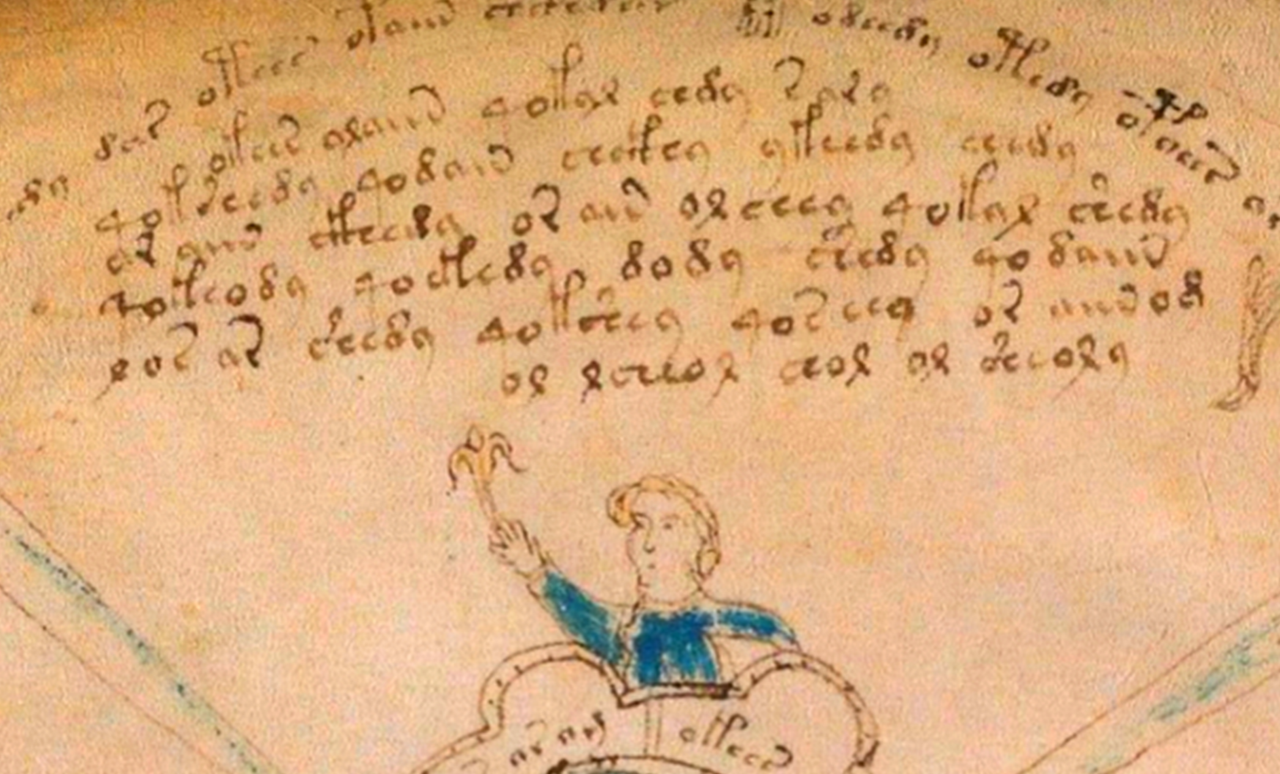
Woman 9 stands at the end of the fallopian tube and now casts the golden cell toward the uterus.
The long text (35 words) signals that a new and complex phase is beginning: implantation.
Interpretation 1 – “Handover and Attachment in the Uterus”
“My task is complete. I lift the light and release it.
Your next journey begins – in the soft, receptive space.
The cells form a new shape – they cling, open, gather, and live.
Never forget the current behind you.”
Explanation
The embryo is handed over to the uterus.
“The soft space” = the endometrium.
The woman’s hand gesture is a deliberate handover, while the cells are shaped into a blastocyst.
“The current behind you” = the motion and legacy of the fallopian tube.
Interpretation 2 – “Cell Survival and Balance in Implantation”
“You must find the grip and the anchoring.
Use the edge, the folds, and the light from my hand and body.
The splitting is not dangerous – it is your strength, your opportunity.
Everything I was, I have now given to you.”
Explanation
The woman transfers her energy and information.
“The folds” refer to the structure of the uterine lining.
“The splitting” refers to cell division and differentiation.
A poetic, mother-like voice sends the embryo forward.
Interpretation 3 – “Transformation and the Beginning of Embedding”
“Now you must open your sides and stretch the shell.
Feel the edge, the wall, the warmth, and the space behind the forms.
Here you begin to take form, take direction.
I am the wind behind you – still carrying your fire.”
Explanation
The embryo is encouraged to take an active part in implantation.
“The shell” = zona pellucida, which the embryo must break out of.
“The wind” = cilia movement.
“The fire” = the genetic and energetic legacy from the fallopian tube.
Final Circle – The System’s Start and Structure in a Single Motion
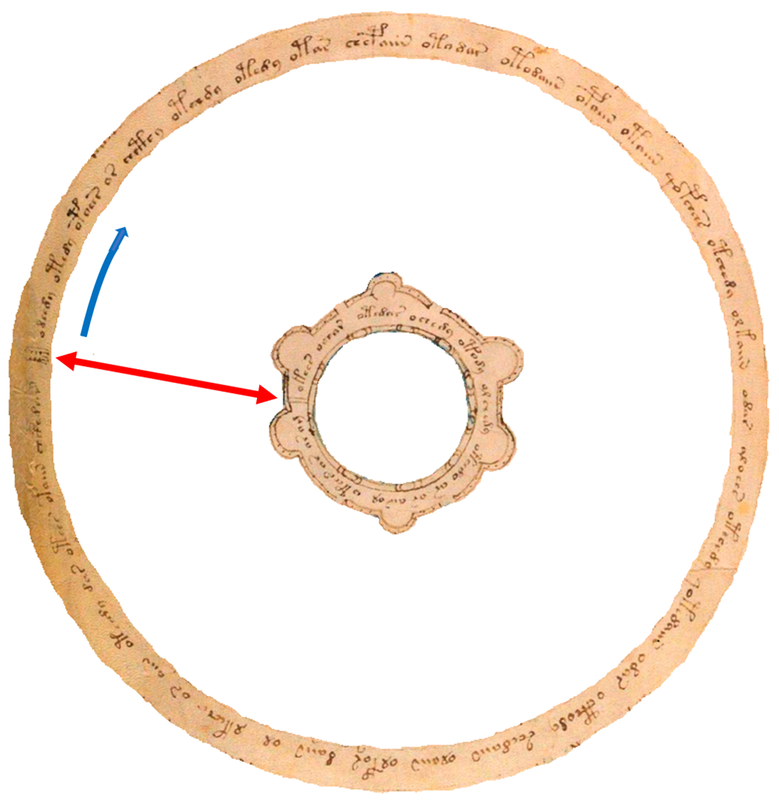
As we reach this final figure, we move both into the very core and all the way out to the edge of the system. In the centre, we see a compact circle with 15 words, which – due to its position close to the “sun-like” centre – likely serves as a kind of starting text or key to the entire system.
In contrast, the outer ring contains a longer text with 35 words, circling around the four outer “petals” that connect directly to Women 12, 3, 6, and 9.
Here, we are no longer in motion – but in structure, rhythm, and perhaps ritual.
Everything is now turned outward – and back to the beginning.
Reading direction and marker points
The red arrow marks the reading marker and the starting point of the outer ring.
The blue arrow indicates the reading direction, which proceeds clockwise all the way around.
The inner ring has its own individual reading marker and is read separately.
It may represent the original textual centre of the entire page.
Interpretation and Possible Readings of the Text Content
Inner Ring – 15 Words
Interpretation
This short text appears to open the entire system. It lies closest to the sun-point and is surrounded by “energy arcs.” It likely contains the key to ovulation, the 10 eggs, and the connection to the daily rhythm.
Possible content (15 words)
“Here the cycle begins. The sun creates the 10 eggs that move outward – with rhythmic force.”
Outer Ring – 35 Words
Interpretation of the outermost ring of text
This is the most open-ended text and the hardest to decipher with certainty. It lies at the outer edge of the entire structure – beyond the women, the central egg, and the four energy arcs.
It appears detached from the biological logic of the centre, and the most likely interpretation is therefore that the text either:
• provides a general description, or
• functions as a reflection or framework for the whole system.
It may:
• summarise the roles and functions of the four women in the cycle, or
• repeat key elements in poetic or rhythmic form – like a kind of ritual or mantra.
There is likely no new information, but rather a structural explanation, a summary, or a closing line that can be “read again and again.”
Possible content – Attempt 1
“The four currents carry the egg forward in rhythmic balance and inner motion.
Each woman divides, receives, and passes it onward.
Day follows night.
Nothing is halted.
Everything continues – with the sun, in the body, through time, toward life.”
Possible content – Attempt 2
“Woman 12 calls the egg forth in light and energy.
Woman 3 splits it in two.
Woman 6 lifts it forward.
Woman 9 releases it inward.
Four actions.
One cycle.
A beginning unfolds.”
Possible content – Attempt 3
“Read the circle in rhythm with the sun, the body, the day, and the pulse.
Four points grasp and release the egg.
Each woman opens a door.
Everything is connected.
Everything repeats.
Everything is born as a single, unified system – with direction.”
Note on Uncertainty
The outer text is written with a certain distance and placed in a circular pattern, which makes it difficult to connect it clearly to any specific phase in the woman’s cycle.
For this reason, I have chosen to be open in the interpretation and acknowledge that there may be uncertainty.
Still, the reading is grounded in the overall structure of the image, the placement of the four women, and the biological elements that are repeated throughout the manuscript.